Every census since 1790 has answered not only the question of how many people live in the country but also: where does each person in the country live? The answer determines representation, redistricting, and allocation of federal funding. The answer also undergirds data that are used for health, education, business, emergency planning, research purposes, and much more.
The U.S. Census Bureau’s definition and rules of where someone lives have evolved over the history of the decennial survey. For example, where should a college student be counted? Where do we count someone if they moved partway through the year? What has not evolved is the inclusion of each person in the United States in the survey, and the question that remains is where that person needs to be counted.
The U.S. Commerce Department’s proposed rule for the 2030 Census changes this course. The proposed question is, essentially: where were you, lawfully, for the most days between January 3 and April 1, and does your tax return agree?
We have broken down the residency components of the proposal below and how the resulting data could be problematic.
Who is counted?
The U.S. Constitution excluded two groups from the original census count: Enslaved people were counted as three-fifths of a person (this changed under the 14th Amendment in 1868), and American Indians who were “not taxed” were left out until 1940. However, every census since 1790 has counted noncitizens who live here.
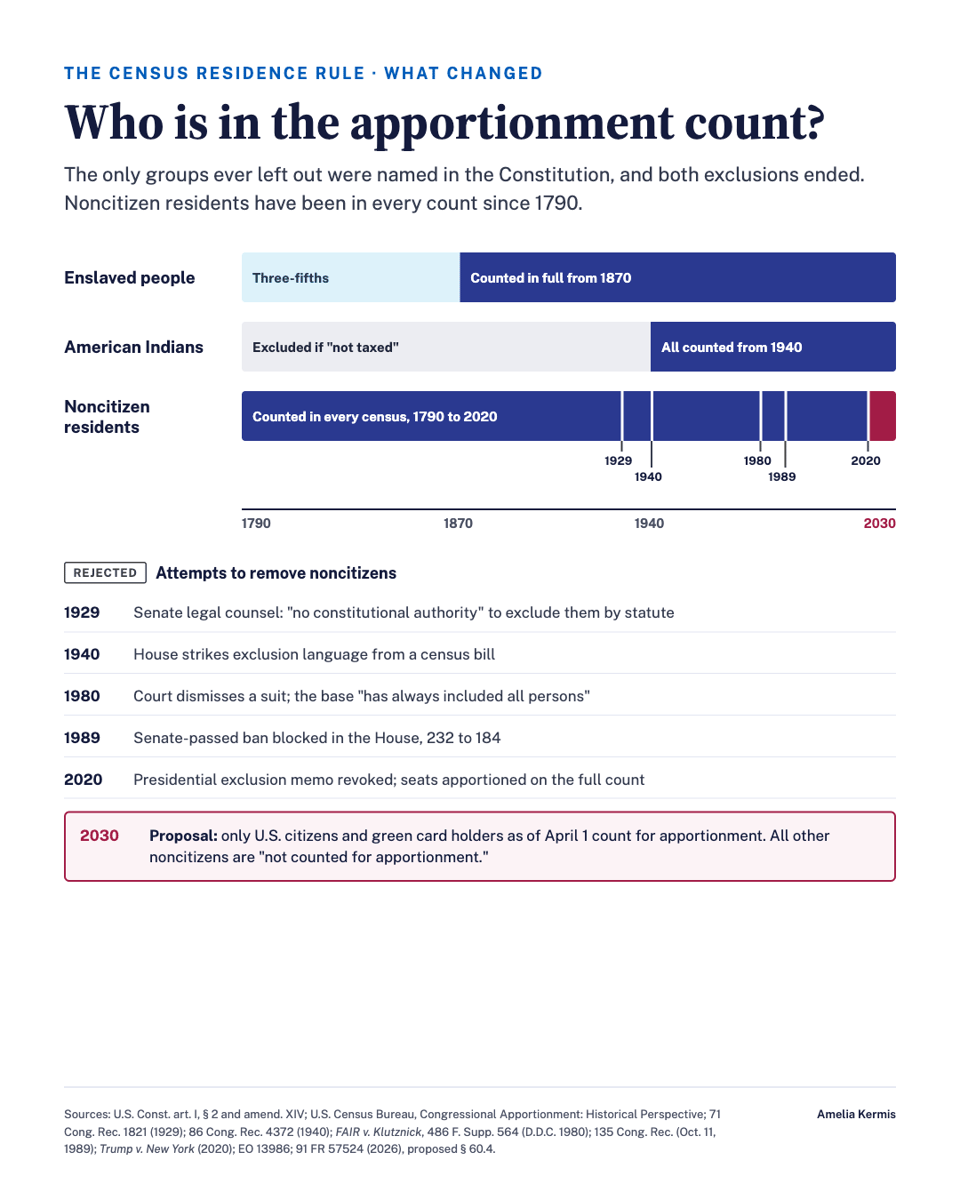
As indicated, there have been five serious attempts to exclude noncitizens from the decennial census, but none have stuck. The most recent was a 2020 presidential memo that tried to drop undocumented immigrants from the apportionment count after a Supreme Court Decision blocked an effort to add a citizenship question on the 2020 census form. The memo was revoked by the incoming Administration.
This current proposal would count only U.S. citizens and green card holders for apportionment. This is the largest elimination related to noncitizens yet, as it goes beyond undocumented immigrants to include visa holders, recent refugees, asylum seekers, and others who are in the U.S. lawfully. The potential impacts could be significant: not counting all persons living in the United States as required by the Constitution would malapportion the House of Representatives.
Beyond apportionment, the revised data could be used for redistricting, federal funding, and as the base for additional data collection (such as the Bureau’s annual American Community Survey– which uses decennial race counts to calibrate).
When are they counted?
Since 1790, Census Day–the date used to decide where each person is counted–has been changed four times, each time to make it easier to find people at home. The only winter date, January 1, 1920, lasted one census, and in 1930, April 1 became Census Day. While the Commerce Department does not seek to do away with April 1 as Census Day, the proposal changes the “when” question in practice. The proposal describes residence from January 3 to April 1, counting each person where they “lawfully spend the greatest number of days” during that period and must be consistent with tax records.
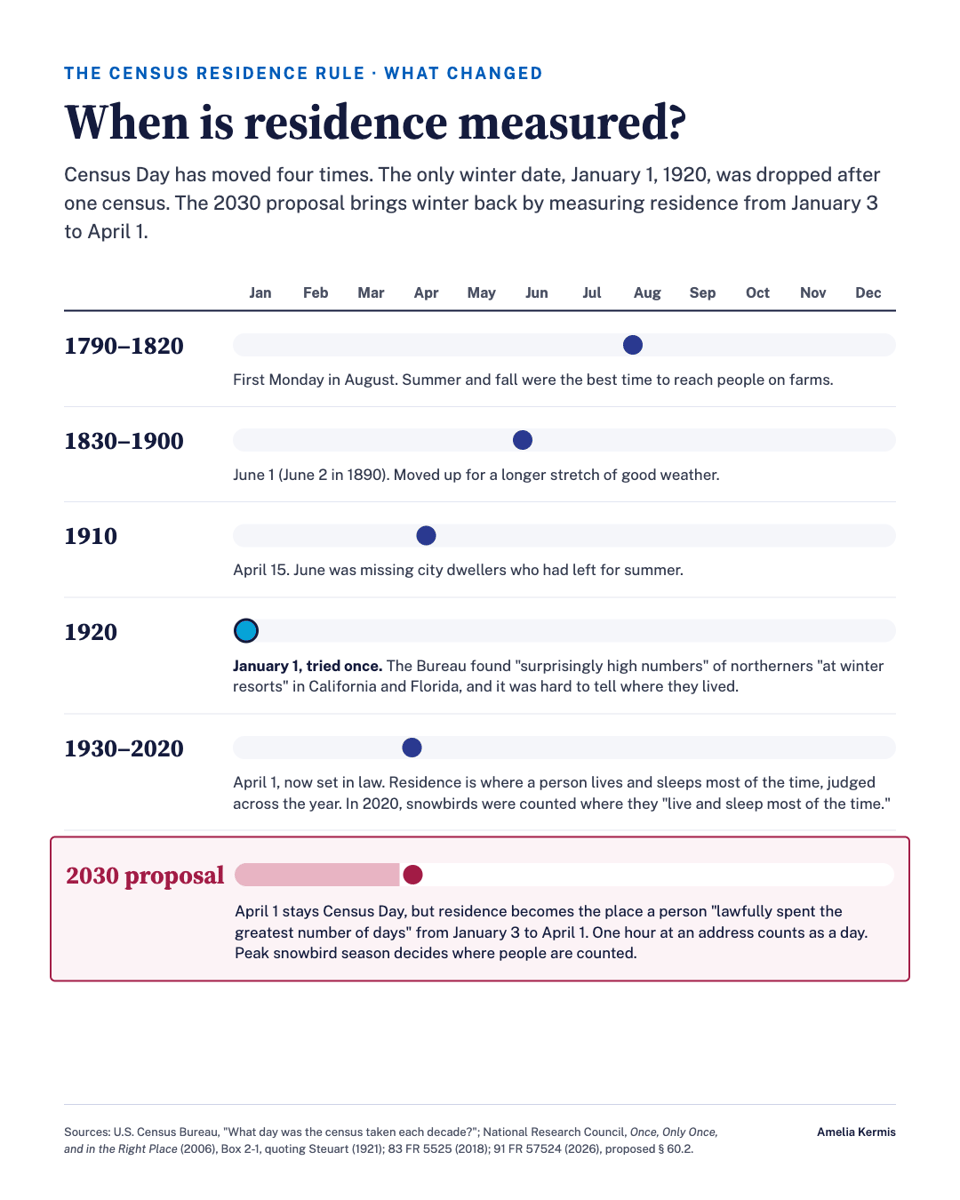
With the proposed rule, the simple question of where you live on April 1 has turned into multiple questions with no clear answer. How does a family filling out the form on April 1 tally three months of days across every address they might have? Which of those days were “lawful”? What happens when tax records show a mailing address rather than where someone slept, or when a person doesn’t file taxes at all? People who answer the same situation differently will be counted in different places, leaving the count inaccurate and unreplicable.
How do we count students?
Shifts in where and when college students are counted show what happens to data when a residence rule flips. The most recent change took place in 1950–when the Bureau switched to counting college students at school rather than at their parents’ home–and numbers changed drastically overnight.
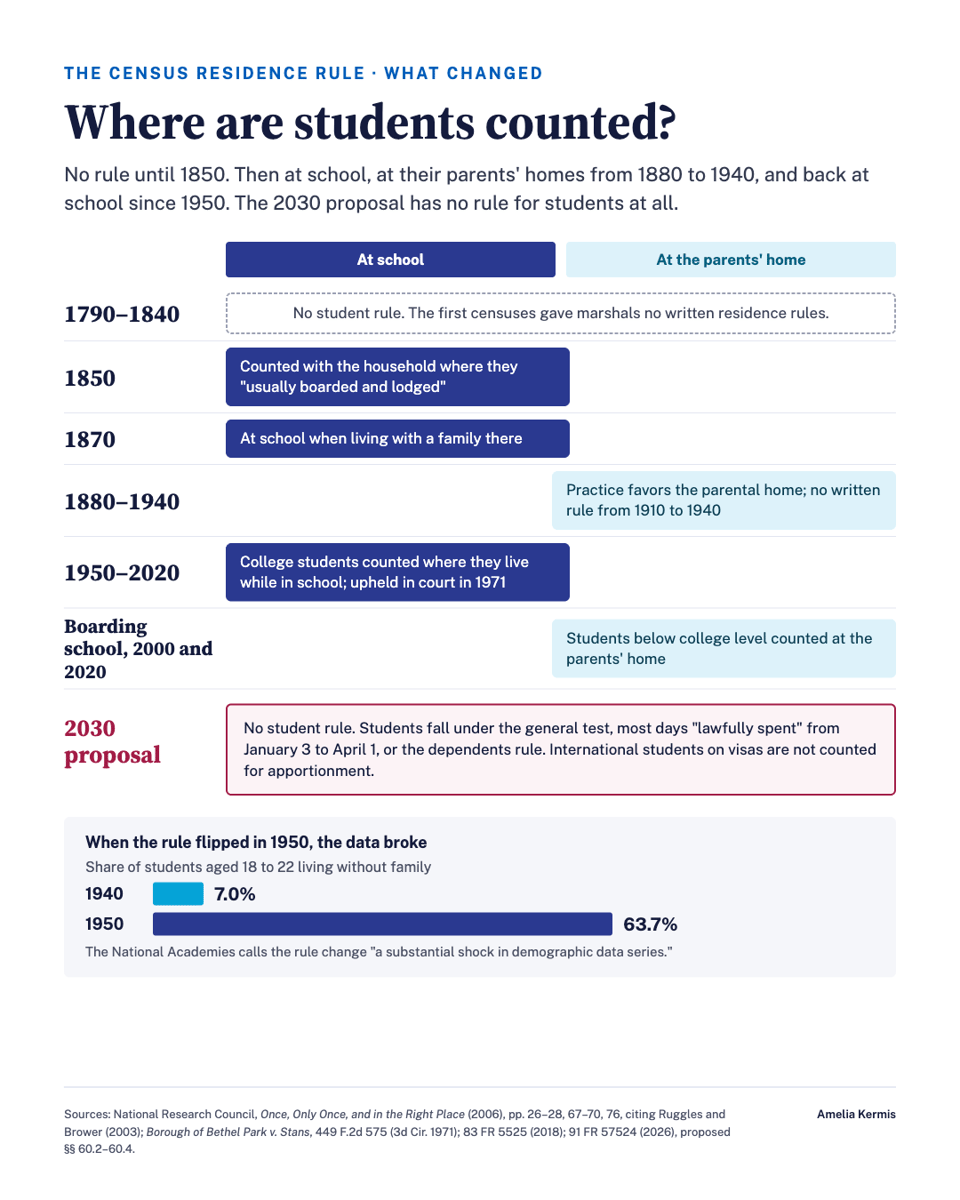
The share of students aged 18 to 22 counted as living without family jumped from 7 percent in the 1940 Census to 64 percent in 1950. College students’ lives didn’t change that much over the course of a decade, but the rule change made it look like they did. The National Academies called it a “substantial shock in demographic data series.”
The 2030 proposal, on the other hand, has no student rule at all. Students would fall under the rule’s general residence definition, or the rule for dependents, and international students on visas wouldn’t be counted for apportionment. January through March is the spring term for colleges and universities, but students claimed as dependents would show up on their parents’ tax returns–with potentially extreme consequences on college towns, for example. Additionally, the confusion could cause students to be double-counted–once with their parents and once at school–further degrading the count’s accuracy.
What are the impacts of the proposed rules?
Past changes moved one piece of the rule at a time: where college students were counted, or which day the count was taken. That allowed the Bureau to build a crosswalk, a side-by-side match of the old and new counting methods, so that the group’s numbers stayed comparable across decades. The 2030 proposal changes who counts, when residence is considered, and how residence is proven–all at once. It also writes those changes into permanent regulation, binding every subsequent decennial census unless future rulemaking changes it. Any difference in data between 2020 and 2030 would be due to either real population change or rule change, and there would be no way to determine the true cause.
What you can do
If your work depends on comparing census data over time, submit a public comment. Tell the Bureau what you track, what the risks are to your work, and who relies on your work. Comments are due November 2, 2026, through the regulations.gov portal. To get started, see the comment guides at Roadmap to 2030 and Hands Off Our Census.