By Lynda Kellam, Director of Research Data & Digital Scholarship at the University of Pennsylvania Libraries and co-Founder of the Data Rescue Project, and Meeta Anand, Senior Director for Census and Data Equity at The Leadership Conference on Civil and Human Rights
Most people don’t think much about the information that the federal government collects through the U.S. Census until it disappears. But when we lose census data, we lose irreplaceable, objective information that anyone can access and use, for free. And that equality of access is fundamental to the research community.
Lynda tells a story that brings this into sharp relief:
When I was the data librarian at the University of North Carolina at Greensboro, I often taught workshops for students on finding and using datasets. One day in the fall semester of 2013, I was teaching a workshop to a Marketing class. The professor had tasked the students with developing marketing plans for local community-based organizations in Greensboro. To do this, they needed to understand the communities these organizations served and their needs. One of the primary data sources my students were using for this assignment was the U.S. Census Bureau’s American FactFinder, which, at the time, was the portal for accessing the American Community Survey (ACS) and the decennial census, the premier population surveys in the country (the Bureau discontinued the American FactFinder in 2019 and transitioned its data releases to data.census.gov).
The American FactFinder was the best source for my students’ work, because together, the decennial census and ACS provide uniquely comprehensive, detailed, and up-to-date information about Greensboro’s communities, right down to the block level. No other private or public data source could then or can now replace census data. In fact, census data serve as the foundation for nearly all other surveys and datasets, because they are the benchmark that ensures that a survey’s sample accurately reflects a given area’s larger population. The fact that census and ACS data are publicly accessible was also critical for my students, because our library had a relatively modest collection budget and few other sources beyond freely available government data.
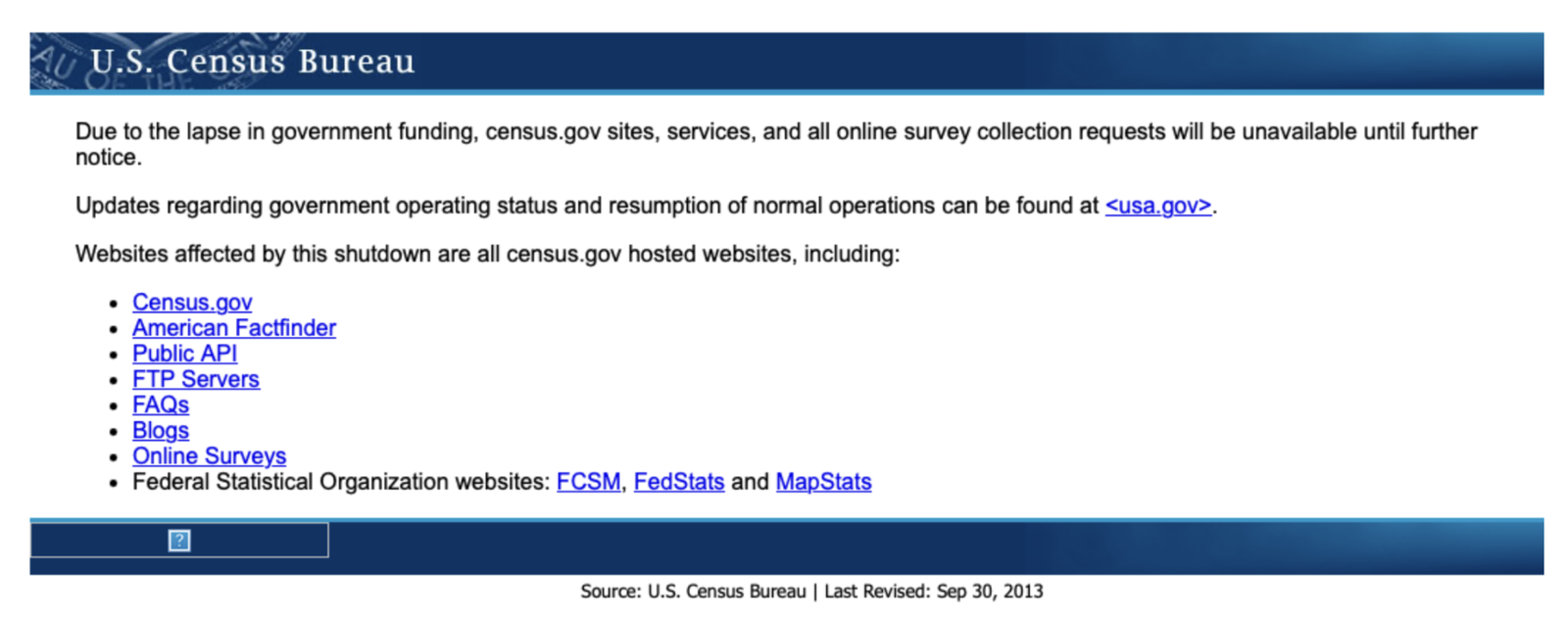
My workshop with the Marketing class was going along well. I demonstrated how to use American FactFinder and was about to give the students some time to work on their own. Then, suddenly, American FactFinder went dark. We were met with the following message on the Census Bureau’s page:
U.S. Census Bureau, last revised Sept 30, 2013.
My students were left without any data to inform their market planning—meaning that the community-based organizations in this scenario would be less effective in reaching the people who needed their services.
The loss of census data had an incredible impact on the course of our class. Since census and ACS data remained unavailable for about three weeks, the students had to pivot to other, less comprehensive and reliable data sources for their market planning. Our university did not have the budget to collect its own data or purchase many vendor databases, which can cost more than $10k—we simply couldn’t afford them. We, like many other institutions with limited resources, depended on the reliable census data that came to us free of charge from the federal government.
In the data rescue and data equity communities, we often talk about public data, like data from the census and ACS, as a kind of infrastructure. And, as with infrastructure like roads and bridges, we tend to recognize its importance only when it is failing. When it is freely available, we often take it for granted and assume it will always be there. But when these data suddenly disappear, alternative sources almost always come with a cost, and they may not be as trustworthy, accurate, or comprehensive. And the people most often affected by the loss of public data are those with the fewest alternatives.
Now, leading up to the 2030 Census, we are facing an even more dire census data crisis. On September 10, the Census Bureau proposed major changes to the census that would severely undermine the completeness, accuracy, and usefulness of census and ACS data. These changes would suppress the count of many groups of people and limit the types of demographic questions the census asks, effectively erasing whole communities from census data. The U.S. Census Bureau is also not following its usual rigorous processes for researching, testing, and consulting expert stakeholders about proposed changes to the census, putting the integrity and reliability of the data it collects at serious risk.
Lynda’s students didn’t think of themselves as census data users when they walked into the classroom. They were marketing students trying to help local nonprofits. But their research depended on a federal data infrastructure they had probably never thought about until it disappeared. An independent Census Bureau, with processes guided by scientific integrity, rigorous testing, and public input, is at the heart of this infrastructure. Incomplete and inaccurate census data would once again leave researchers and data users like Lynda's students in the dark, unable to effectively identify and meet the needs of their communities.
Public data, including census data, are a public good. We the people have the right to accurate, objective, and publicly accessible information about our communities. To uphold this right, the census must count everyone fairly, accurately, and without politically motivated exclusions.
This blog was adapted from a talk given by Lynda Kellam: Kellam, L. (2026, August 26). Public Data as a Public Good: Lessons from Data Rescue and Beyond. Zenodo. Foundations of Research Computing FORC Camp, New York, NY. https://doi.org/10.5281/zenodo.22119139